Imagine you are a stingray hiding beneath a layer of sand. Nothing can see you, and it feels as if the danger has passed. Then a hammerhead glides over the seafloor. It sweeps its wide head from side to side, suddenly turns, and heads straight toward your hiding place. How did it know you were there?
The answer lies in that strange head. It helps the shark notice what is around it, sense prey it cannot see, and turn quickly through the water. But that is only the beginning.
Some hammerheads are shorter than an adult human, others grow longer than a car, and one species can even digest seagrass. Let’s discover how these sharks really live—and which famous hammerhead stories are actually true.

10 Amazing Hammerhead Shark Facts
- The “hammer” has a scientific name. It is called a cephalofoil. Cephalo- comes from the Greek word for “head,” while foil means a flat, wing-like surface that moves through water. Put the two parts together, and the name describes the shark’s wide “head wing.”
- A hammerhead is not just one kind of shark. The family contains more than ten living species. Our size comparison below shows only four very different examples—not the whole family.
- Their wide-set eyes improve their view. Some hammerheads have a wider visual field and more binocular overlap than sharks with narrow heads—but they do not literally see everything at once.
- They can find prey hidden under sand. Electrical sensors in the head detect extremely weak signals produced by living animals.
- Their sizes are dramatically different. A bonnethead may be shorter than an adult human, while a great hammerhead can reach about 20 feet (6.1 m).
- The head can become a hunting tool. Great hammerheads have been observed pinning stingrays against the seafloor before biting them.
- One hammerhead can digest plants. Bonnetheads eat plenty of animal prey, but research shows that they can also digest nutrients from seagrass.
- Hammerhead pups do not hatch from egg cases left on the seafloor. They grow inside their mother and are born alive, already able to swim on their own.
- Some gather in spectacular schools. Scalloped hammerheads may form large daytime groups near oceanic islands and seamounts.
- Hammerheads do not hunt people for food. They hunt animals such as fish, rays and squid. Large hammerheads are still powerful wild animals, but confirmed unprovoked bites are rare.
Those were ten facts in a nutshell. Now for the most interesting part. Our story begins with the feature that makes a hammerhead impossible to mistake: its extraordinary head.
Why Do Hammerhead Sharks Have Hammer-Shaped Heads?
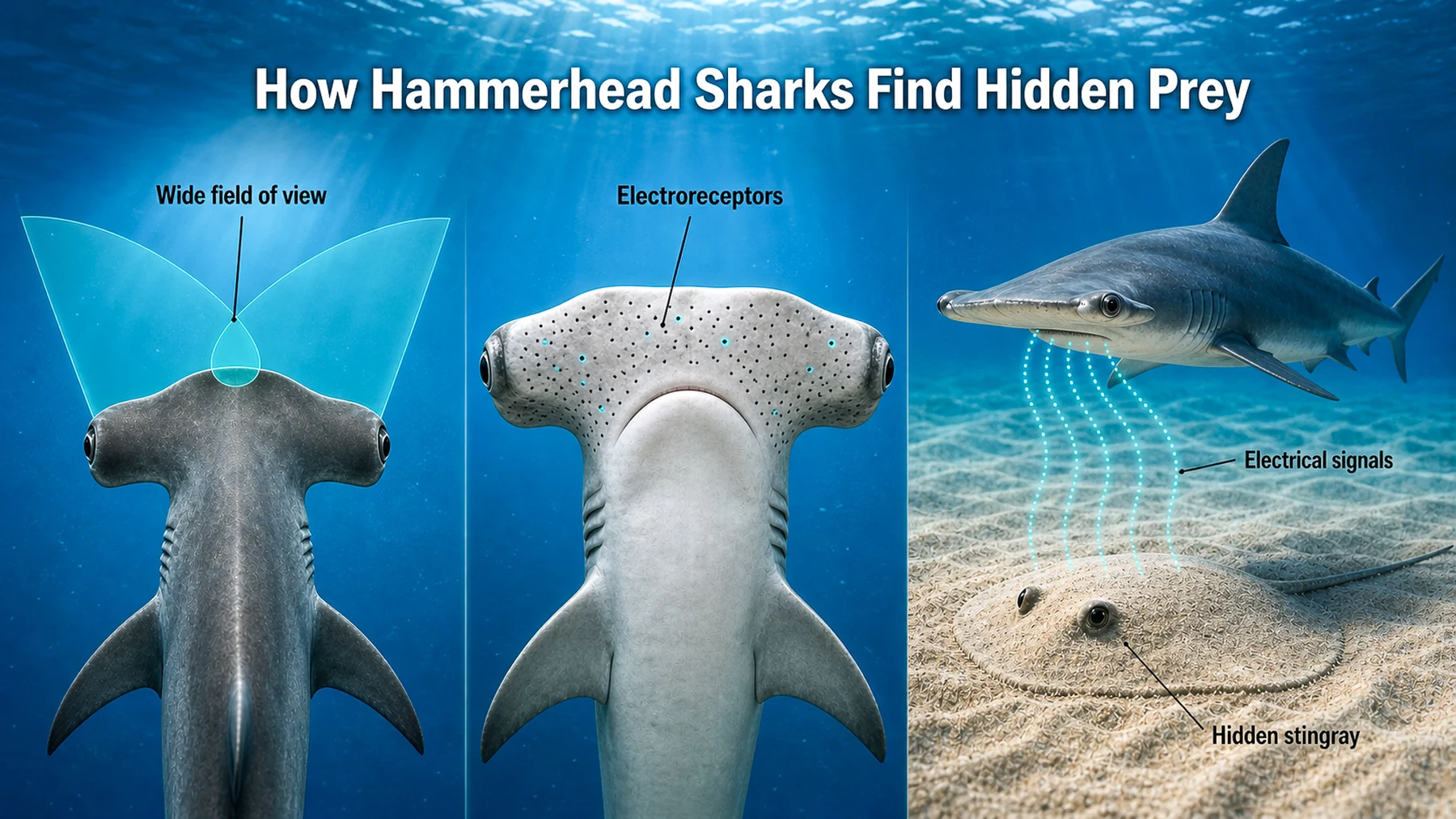
Imagine a hammerhead sweeping its wide head over the sand like a metal detector. Its eyes at the ends help it look in different directions, while tiny sensors feel a stingray hiding below—even when the shark cannot see it. Once the ray is found, the wide head helps the shark turn quickly and can even help pin its meal to the seafloor.
Because its eyes sit far apart, a hammerhead can watch a wide stretch of water. There is also an area in front of the shark that both eyes see together, helping it judge how far away something is. Scientists call this binocular vision. The shark does not have perfect 360-degree vision, though. It still has blind areas and must move its head and eyes to follow what is around it.
Now look underneath the head. It is covered with tiny pores that work like sensors. They feel the weak electrical signals made by the nerves and muscles of other animals. Scientists call these organs the ampullae of Lorenzini. All sharks have them, but a hammerhead spreads them across a much wider surface. A ray may disappear beneath the sand, but it cannot hide the tiny signals made by its living body.
The wide head also changes the way the shark moves through water. It works a little like a broad steering surface, helping the shark make sharp turns, although pushing such a wide head through water takes extra effort. A great hammerhead can even use it as a tool, pressing a stingray to the bottom while turning to bite.
Myth or fact? “A hammerhead can see 360 degrees” is an exaggeration. “Its wide head gives it an unusually broad and useful view” is the more accurate fact.
The hammer-shaped head is the family feature, but the sharks carrying it are certainly not all the same size.
How Big Do Hammerhead Sharks Get?
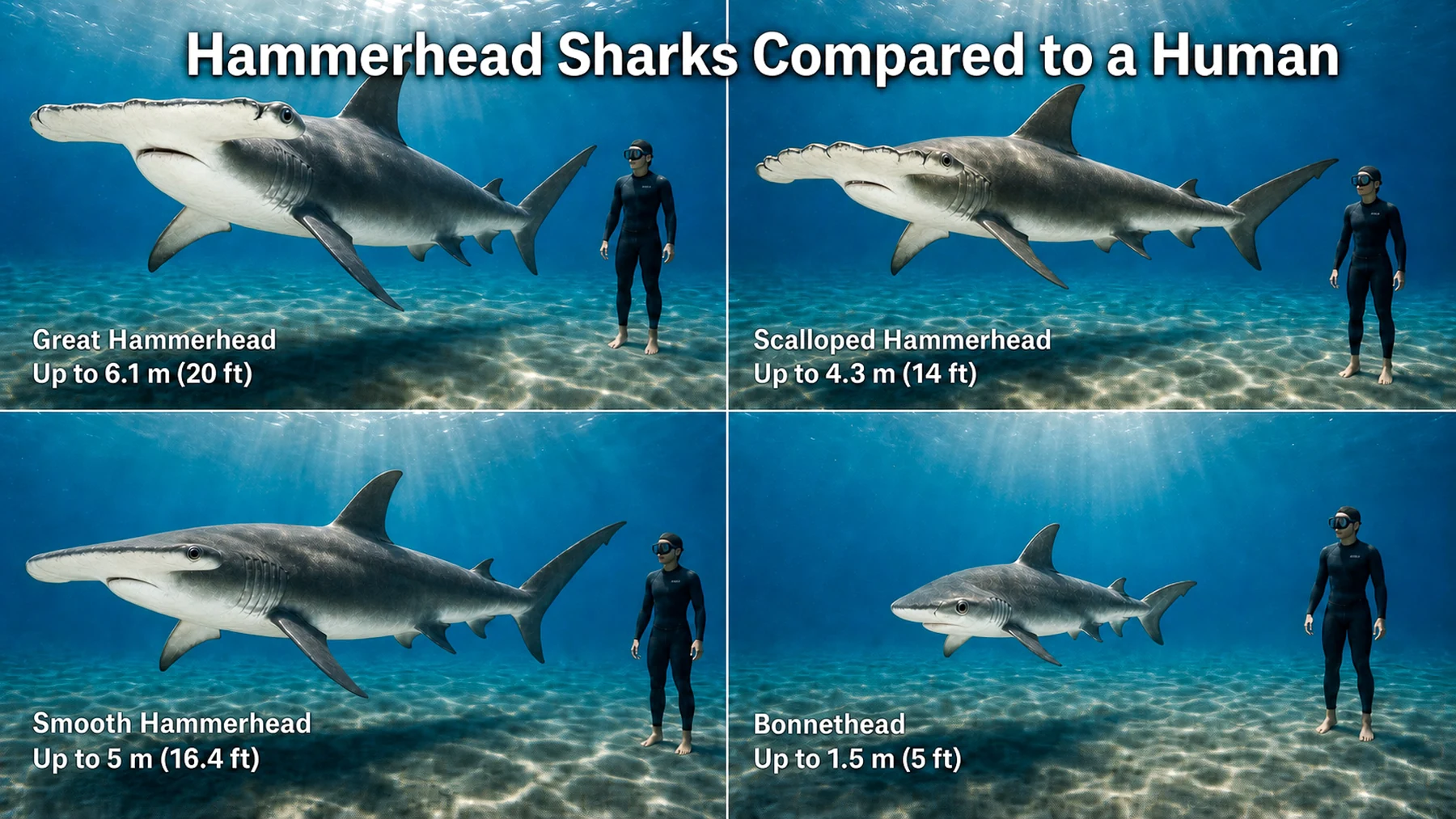
A bonnethead can be shorter than an adult human. At the other extreme, an exceptional great hammerhead can be longer than a family car. More than ten living hammerhead species are known; here we compare only the four shown in the illustration—three large hammerheads and the much smaller bonnethead.
| Species | Approximate maximum length | How to recognize and remember it |
|---|---|---|
| Great hammerhead (Sphyrna mokarran) | About 20 ft (6.1 m) | The front of the head is almost straight, and the first dorsal fin rises like a tall sail. It is the largest hammerhead and a skilled stingray hunter. |
| Smooth hammerhead (Sphyrna zygaena) | Up to about 16.4 ft (5 m) | Its broad head has no notch in the middle, so the front edge looks smooth. It enters cooler water than many of its relatives. |
| Scalloped hammerhead (Sphyrna lewini) | Up to about 14 ft (4.3 m) | The front edge of its head is wavy, almost like a scallop shell. These sharks can gather in large schools near islands and underwater mountains. |
| Bonnethead (Sphyrna tiburo) | About 5 ft (1.5 m) | Its small, rounded head looks like a shovel. It eats crabs and shrimp and can also digest some seagrass. |
These figures are approximate upper limits, not the size of an ordinary adult. Published estimates sometimes differ, and most great hammerheads, for example, are far shorter than 20 feet. Females also grow larger than males in several hammerhead species.
Different sizes also mean different ways of hunting—and very different menus.
What Do Hammerhead Sharks Eat?
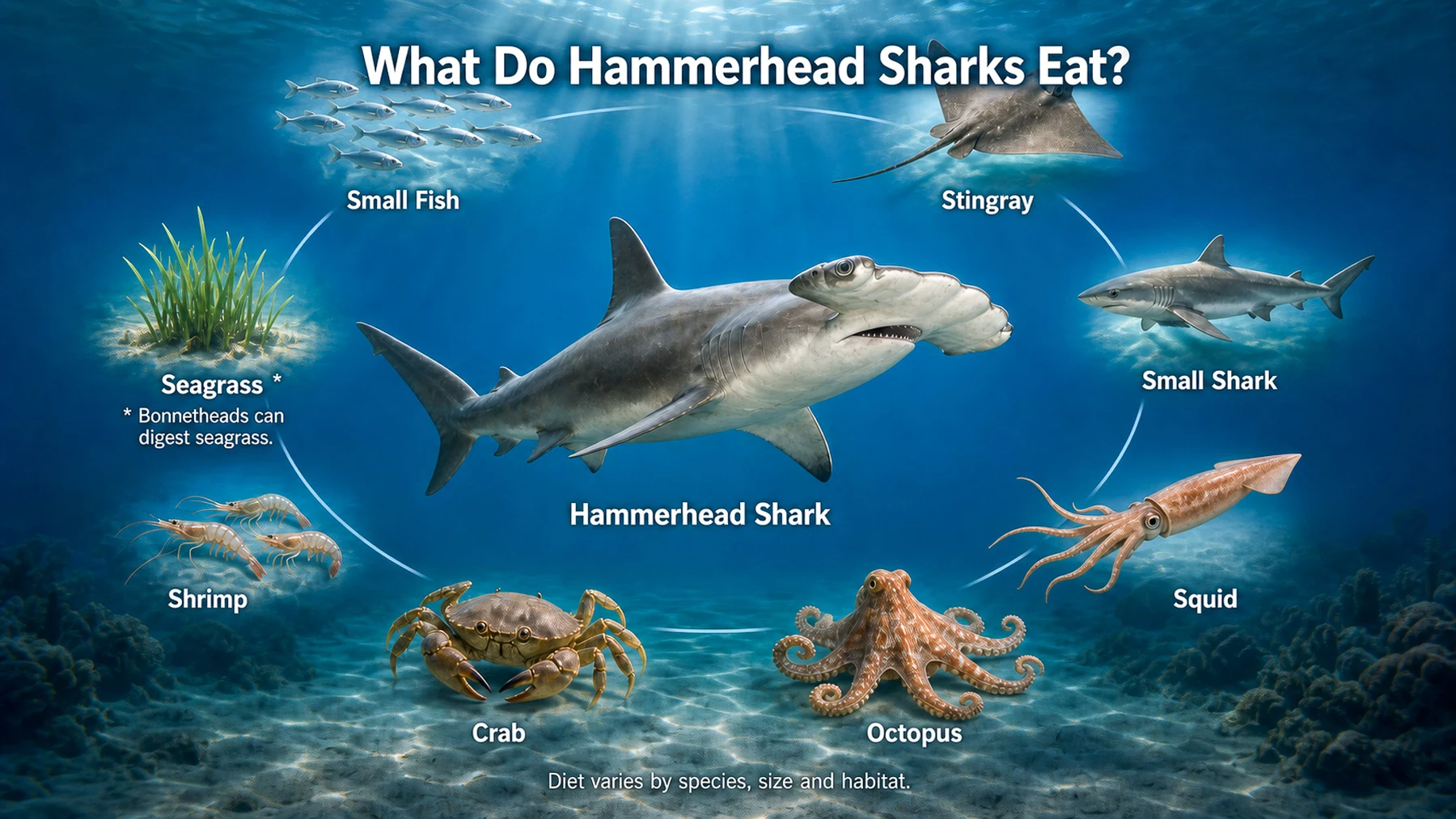
Hammerheads eat fish, rays, squid, octopuses, crabs, shrimp, and sometimes smaller sharks. There is no single menu for the entire family.
Large species such as great, scalloped, and smooth hammerheads are active predators. Stingrays are especially important prey for great hammerheads. Ray spines have even been found embedded around the mouths of some sharks, showing that this meal can fight back.
Bonnetheads hunt closer to shore and often crush crabs and other hard-shelled prey. Their front teeth help seize food, while flatter teeth farther back help break shells. They also swallow seagrass while feeding. Experiments show that bonnetheads can digest some of it and gain nutrients from it. They are not underwater cows—their diet still includes plenty of animal food—but this ability makes them unusual among sharks.
To catch such different meals, hammerheads need more than a wide head. Their eyes, teeth, and even their skin are built for life as constantly moving ocean predators.
Hammerhead Shark Eyes, Teeth and Skin

Imagine a hammerhead gliding close past an aquarium window. Three details are worth looking for.
Eyes
Seen from the front, the eyes look almost like two lookout posts at the ends of the head. Their position gives the shark a broad view, but it still has blind spots. A hammerhead keeps moving its head and body to follow what is happening around it.
Teeth
There is no single hammerhead tooth shape. Larger species have pointed or triangular teeth for gripping and cutting fish and rays. Bonnetheads need a different tool: teeth that can grasp prey at the front and crush crab shells farther back.
A lost tooth does not leave an empty space for long. New teeth grow behind the working rows and slowly move forward like objects on a conveyor belt. This replacement continues throughout the shark’s life.
Skin
Hammerhead skin is covered with tiny tooth-like scales called dermal denticles. They point backward and help water slide smoothly over the body. If it were possible to touch the shark safely, its skin would feel smoother from head to tail and more like sandpaper in the opposite direction.
How Do Hammerhead Sharks Live?
Watching a hammerhead for a few minutes reveals only a tiny part of its life. Some spend much of their time alone, others gather in great schools, and every one of them begins life as a pup that must survive without a parent beside it.
Do hammerhead sharks live alone or in groups?
Imagine hundreds of hammerheads slowly circling above an underwater mountain. This spectacular sight is most often created by scalloped hammerheads. During the day they may gather near oceanic islands and seamounts, then spread out to hunt, especially at night. Great hammerheads are more often seen alone, while bonnetheads may travel in smaller coastal groups.
Scientists are still working out exactly why the schools form. Social contact, navigation, safety, mating, and visits to cleaner fish may all play a part. The important point is that the enormous schools in photographs do not represent every hammerhead species.
How are baby hammerhead sharks born?
Baby hammerheads do not hatch from eggs left on the seafloor. They develop inside their mother and are born alive. While growing, they receive nourishment through a connection called a yolk-sac placenta. A bonnethead may have a small litter, while a large scalloped or great hammerhead can carry several dozen pups.
Some pregnant females enter shallow bays to give birth. These sheltered places act as nurseries, but the mother does not stay to raise her young. From their first moments in the water, the pups must swim, find food, and avoid larger predators on their own.
How long do hammerhead sharks live?
A shark does not carry a birthday record, so scientists look for growth bands in its vertebrae, almost like reading rings inside a tree. The method is useful but not perfect, which is why estimates can differ.
There is no single lifespan for the whole family. Bonnetheads may live roughly 16–18 years, while scalloped hammerheads can survive for more than 30 years. Large hammerheads may live for several decades.
Do hammerhead sharks sleep?
Hammerheads rest, but they do not climb into a bed or close down for the night like people. Even while resting, oxygen-rich water must continue to pass over their gills. A hammerhead may slow down without becoming completely still, and not every species necessarily rests in exactly the same way.
Learning how these sharks live leads to the question many families ask first: what happens if there is no aquarium glass between a hammerhead and a person?
Are Hammerhead Sharks Dangerous to Humans?
Hammerhead sharks do not hunt people for food. They are powerful wild predators, but confirmed unprovoked bites are rare, and smaller species such as bonnetheads are not considered a serious danger to people.
The great, smooth, and scalloped hammerheads are large enough to injure a person. A bite could occur if a shark feels trapped or threatened, if someone chases or touches it, if speared fish or bait are nearby, or if people feed sharks and change their natural behavior. A curious close approach is not automatically an attack.
If you see a hammerhead while swimming or diving, stay calm, keep the shark in view, give it a clear path, and do not chase, touch, or feed it. Leave the water calmly if the shark repeatedly approaches or appears agitated. Local guidance from trained dive operators and beach authorities should always come first.
Would you know what to do if a shark appeared nearby? Read our complete shark safety guide for a simple explanation of shark behavior and the safest way to respond during an encounter.
For most people, a hammerhead is a much smaller danger than it appears. Sadly, the danger runs far more strongly in the other direction: people have become one of the greatest threats to hammerheads.
Why Do Hammerhead Sharks Matter?
Hammerheads matter for more than their extraordinary appearance. Their lives are connected to other ocean animals, scientific discovery, and the people who earn a living near the sea.
Their role in the ocean
Imagine a reef as a busy underwater neighborhood. Rays search for food on the bottom, fish hide among the coral, and squid come out to hunt. When a large hammerhead appears, some animals move away or begin feeding somewhere else. By eating some animals and making others change their behavior, the shark can affect life around it even when it catches nothing. Young hammerheads may also become food for larger sharks, so they are part of the food web in more than one way.
Scientists cannot yet say exactly what would happen if hammerheads disappeared from every place they inhabit. Nature is more complicated than the simple claim that sharks “keep the ocean in balance.” What we do know is that removing a large predator changes relationships that developed over millions of years—and those changes may be difficult to predict or reverse.
Why hammerheads matter to people
Picture a diver travelling to an island in the hope of seeing hammerheads. A local captain takes the boat out, a dive guide leads the group, and the visitor uses local hotels and restaurants. Well-managed shark tourism can support all of those jobs as well as conservation work. A living shark can create value again and again, not just once.
Hammerheads also help scientists study vision, electroreception, animal movement, hydrodynamics, and evolution. Their unusual bodies are natural experiments that show how an animal can adapt to finding food in a difficult environment.
Hammerheads do not need to be useful to humans in order to deserve a place in the ocean. But protecting them can also support scientific knowledge, local jobs, and marine ecosystems that people depend on.
That makes the next fact difficult to accept: some hammerhead populations are disappearing faster than they can recover.
Which Hammerhead Sharks Are Endangered—and Why?
A hammerhead can find a ray beneath the sand, cross great distances, and escape other ocean predators. But evolution did not prepare it for a large fishing net. Not every hammerhead has the same conservation status, but several species are in serious trouble.
Current global assessments list:
- the great hammerhead and scalloped hammerhead as Critically Endangered;
- the bonnethead as Endangered;
- the smooth hammerhead as Vulnerable.
Newly recognized species may not yet have a complete assessment.
Fishing is the main pressure. Some hammerheads are caught deliberately, while others become bycatch—animals caught even though fishers were trying to catch something else. Their large fins are also valuable in the international fin trade. Schooling creates an extra danger: when hundreds of sharks gather in one place, a fishing operation may catch many of them at once. Hammerheads can die after capture even when fishers intend to release them.
Their biology makes recovery slow. Many hammerheads take years to mature and produce far fewer young than fish that release thousands of eggs. A lost adult cannot be replaced quickly by the next generation. Damage to shallow nursery habitats makes survival even harder for young sharks.
International trade rules, fishing limits, protected areas, safer fishing methods, nursery-habitat protection, and responsible tourism can all help. Sharks do not recognize national borders, so protection must follow them across the ocean and through every habitat they need during their lives.
Now that you know how unusual—and how vulnerable—these sharks are, seeing one, even through aquarium glass, may feel completely different.
Where Can You See a Hammerhead Shark?
For most families, the easiest way to see a hammerhead is through the glass of a large aquarium. Meeting one in the ocean may be more exciting, but it requires careful planning—and a wild shark never promises to appear.
Seeing hammerheads in an aquarium
Only very large aquariums can house these active swimmers. Official visitor information currently lists hammerheads at places including:
- Georgia Aquarium in Atlanta, USA — great hammerhead sharks;
- Singapore Oceanarium in Singapore — scalloped hammerhead sharks;
- Tokyo Sea Life Park in Tokyo, Japan — scalloped hammerhead sharks.
Aquarium collections can change when animals are moved or an exhibit is renovated. Check the aquarium’s official animal list shortly before travelling rather than relying on an old blog or photograph.
Seeing hammerheads in the wild
Scuba diving gives you the best chance. Scalloped hammerheads gather around remote islands and underwater mountains in the eastern tropical Pacific. Famous places include the Galápagos Islands in Ecuador, Cocos Island in Costa Rica, Malpelo in Colombia, and the Revillagigedo Islands in Mexico.
At some Galápagos sites, such as Kicker Rock, lucky snorkelers may also see a hammerhead from the surface. The great schools shown in documentaries, however, are usually found on deeper dives. Many of the best sites have strong currents and are meant for experienced, certified divers travelling with a licensed guide.
Think of a wild encounter as a possibility, not an appointment. A responsible operator will never promise a shark, feed one to bring it closer, or chase it for a photograph.
Would you like to see one in the ocean? Explore our guide to where hammerhead sharks live. It brings together countries, islands, and diving areas so you can choose the place where you would most like to look for a hammerhead in the wild.
Frequently Asked Questions About Hammerhead Sharks
What is the scientific name for a hammerhead shark?
There is no single scientific name for every hammerhead because hammerheads make up a whole family. Sphyrnidae is the family name—rather like a surname shared by the group. Most familiar hammerheads belong to the genus Sphyrna, a name derived from the Greek word for “hammer.” The second word identifies the exact species: the great hammerhead, for example, is Sphyrna mokarran.
Do not confuse this with cephalofoil. That is the scientific name for the shark’s wide, hammer-shaped head, not for the shark itself.
Do hammerhead sharks have bones?
No. Like all sharks, they have skeletons made of cartilage rather than true bone. Cartilage is firm but more flexible than bone.
How many teeth does a hammerhead shark have?
The number depends on the species, jaw, and which small replacement teeth are counted. Hammerheads have several rows and continually replace lost teeth, so one fixed number would be misleading.
Are baby hammerheads born with hammer-shaped heads?
Yes. Pups are born with the characteristic widened head. Its exact shape and proportions change as the shark grows.
One Last Look at the Hammerhead
Remember the stingray hiding beneath the sand at the beginning of our story. Now you know why the hammerhead could find it. Wide-set eyes watched the water, sensitive pores detected weak signals under the sand, and the broad head helped the shark turn toward its prey.
The hammerhead family includes small bonnetheads and enormous ocean predators. Some travel alone; others gather in schools. They rarely harm people, yet people have become one of their greatest dangers.
The next time you see the silhouette of a hammerhead, you will know that its head is not a strange mistake. It is one of evolution’s most unusual and effective toolkits for life in the ocean.
Sources
International organizations and authoritative databases
- IUCN Red List of Threatened Species — global conservation assessments and population threats.
- IUCN SSC Shark Specialist Group — expert summaries and current shark conservation information.
- UN Convention on Migratory Species: Hammerhead Shark Fact Sheet — lifespan, reproduction, migration, and conservation.
- UN Convention on Migratory Species: Sharks MOU Species List — internationally listed migratory hammerhead species.
- CITES: Sharks and Rays Identification Guide — identification and international trade listings.
- FAO: Sharks of the World, Sphyrnidae — classic UN species catalogue; older taxonomy should be checked against current databases.
- World Register of Marine Species: Sphyrna — accepted scientific names and taxonomic changes.
Government and museum scientific profiles
- NOAA Fisheries: Scalloped Hammerhead Shark — biology, range, threats, and legal protection.
- NOAA Repository: Description of Sphyrna alleni (2024) — peer-reviewed description of a newly recognized hammerhead species.
- Florida Museum: Great Hammerhead — size, diet, habitat, reproduction, and identification.
- Florida Museum: Scalloped Hammerhead — biology, reproduction, diet, and age.
- Florida Museum: Bonnethead — size, teeth, diet, reproduction, and lifespan.
- International Shark Attack File: Species Implicated in Attacks — confirmed unprovoked incidents.
- Georgia Aquarium: Sharks! Predators of the Deep — current great hammerhead exhibit information.
- Singapore Oceanarium: Learn About Sharks — current scalloped hammerhead visitor information.
- Tokyo Sea Life Park: Voyagers of the Sea — current list of animals including scalloped hammerheads.
- Galápagos Scuba Diving Guide — sites, experience requirements, currents, and possible hammerhead sightings.
- UNESCO: Cocos Island National Park — hammerhead aggregations and world-class diving habitat.
- UNESCO: Malpelo Fauna and Flora Sanctuary — recorded hammerhead aggregations and diving information.
Peer-reviewed research
- Journal of Experimental Biology: Enhanced Visual Fields in Hammerhead Sharks — experimental measurements of hammerhead vision.
- Scientific Reports: A Hydrodynamics Assessment of the Hammerhead Shark Cephalofoil — hydrodynamics and maneuverability of the head.
- Scientific Reports: Trophic Ecology of the Great Hammerhead — diet, movement, and resource use.
- Science: The Ecological Roles and Importance of Sharks — what is known and still uncertain about sharks in marine ecosystems.
- Oryx: The Global Economic Value of Shark Ecotourism — tourism value and conservation implications.
Additional reading for general readers
- National Geographic: Hammerhead Sharks — accessible overview and photography.
- Wikipedia: Hammerhead Shark — useful orientation and links to further references; facts in the article above are supported by the primary and authoritative sources listed first.


